Lecture
International Contributions for Preservation of the Bamiyan World Heritage Site
Date:Thursday, May 31, 2012, 16:20-18:00
Venue:K-222, the Koshien Hall
Lecturer:Mr. Kazuya Yamauchi (Head of Regional Environment Section, Japan Center for International Cooperation in Conservation, National Research Institute for Cultural Properties, Tokyo)
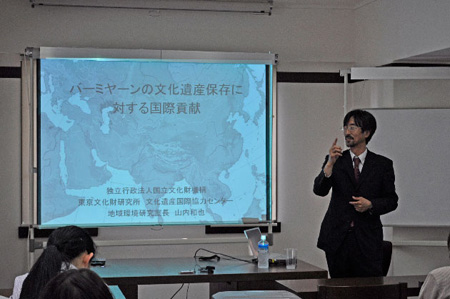
The lecture given by Mr. Yamauchi
Mr. Yamauchi, National Research Institute for Cultural Properties, Tokyo, gave a lecture titled “International Contributions for Preservation of the Bamiyan World Heritage Site”.
Bamiyan is located at the west end of the great Hindu Kush mountain range which extends from southwest to northeast separating Afghanistan in two parts. A Chinese monk Xuan Zang visited Bamiyan in the 7th century AD and recorded its prosperity of the time including West- and East-Giant Golden Buddha statues.
In March 2001, the two Giant Buddha statues were destroyed by the Taliban militia regime and a huge number of murals were lost or looted in the chaos. Hence, the Bamiyan site was hastily declared a World Heritage site as “Cultural Landscape and Archaeological Remains of the Bamiyan Valley” and added to UNESCO’s List of World Heritage in Danger in 2003. And safeguarding projects for the site are currently being conducted by several institutions of the world including that of Japan, Germany, Italy etc. under the coordination of UNESCO. In Japan, National Research Institute for Cultural Properties, Tokyo, is taking the lead in the projects including preservation of mural paintings, archaeological survey to determine the scope of the ruins to be preserved etc.
In the lecture, Mr. Yamauchi illustrated the Bamiyan site from various angles such as its history and current conditions, international projects to preserve mural paintings, archaeological surveys conducted by Japanese team, and concept of development and preservation of cultural heritage in Afghanistan. He also introduced the types of houses in the caves and the lifestyle in Bamiyan, a knowledge which can be gained only through field survey, and the cave’s style and structure derived from Buddhist elements as well as relationships between the site and the Islamic culture.